
My trash writing, Frantz Fanon and Paul Beatty

I set up this blog out of frustration. I had written something, which I thought had some value, but I couldn’t seem to get it published. Not without mutilating it. This has happened over, and over again, and I’d grown tired of arguing with gatekeepers over the inconsistencies and shifting standards they were using to keep me out.
That’s less narcissistic than it might sound. This doesn’t just happen to me. Way too often, the work of far too many people is rejected under the guise of judgements concerning good work. That is, for many of us, especially those of us who don’t neatly fit into the categories and the understanding of those in decision making positions, the unfamiliarity of our bodies and lived experiences often leads to our work being judged lacking. The choice we are then confronted with is to conform, or to stay out. I didn’t want to conform.
Interestingly enough, after posting it on this platform, my article was subsequently picked up elsewhere1. I planned to keep blogging, but I then got busy teaching, adjusting to Zoom’s takeover of my professional life, and managing the emotional fallout of COVID isolation and #BLM protests continuing to go unheeded. I should have kept blogging. I used to blog regularly2. I’d like to get back into it, and this is a really good place to do that, despite my reticence to share my views publicly.
That may sound strange. My best attempt to express that reticence, to date, is a fragment that I abandoned years ago. It’s a terrible piece of writing, but it’s important to me for two reasons. First, going over and over that piece, working at it again and again but realising that it was still trash, helped me to realise that I’m no novelist or fiction writer. That’s just not my lane. And yet, secondly, terrible as it is, that piece contains something precious - a kernel of truth.
I’ll show you what I mean. Here’s the fragment:
“How do you tell someone something they don't want to hear? What if one day, someone came to you and said that the sky wasn't blue, nor water wet; that pain wasn't bitter and misery was really sweet?”
“A child might be intrigued, but you... What happens when you, whose world is as alien as sweet misery, are asked by someone who belongs to this one, to explain yourself? Where do you start? Do you just paint a picture they can recognise, no matter how distorted? Do you keep your respectability and stay in the fold? Or do you come to terms with your unintelligibility and consequent irrelevance?”
Even as he spoke the words, he knew what they were thinking. The old man knew life would be so much simpler if he just followed his own advice and kept silent. He was the sensible one. He knew full well what happens when you stray. The greatest wrong, when living in a mad-house, is to have the presumption to be anything but mad yourself. He knew that better than most. And yet... And yet some valve inside him failed.
Despite his desire to squeeze it shut, some sphincter inside was growing increasingly redundant. He just couldn't keep the words in. So against his better judgement, against all he knew to be sensible, and wise, and most important, key to survival, he had begun to speak. He knew that just as the initial drip of the tap whose washer is worn will inevitably turn into an unrestrained flow, so too would words eventually escape him, and that to his ruin. Lately, every time he opened his mouth, he came closer and closer to accusing them, and by that, condemning himself.
That writing is almost a decade old. The sphincter imagery is unfortunate, to say the least. I don’t know what I was thinking. To be clear, I have enjoyed academic play with the scatalogical (most explicitly in works on African philosophy3,4 - an observation which warrants scrutiny down the track), so my issue isn’t with obscenity5. Here though, it’s just “extra,” as is the opening dialogue. That said, I really was trying to make sense of something. I was echoing a sentiment that I would later read in Frantz Fanon’s Black Skin, White Masks: ‘The Black must no longer be confronted with this dilemma: whiten yourself or disappear, but must be able to grasp consciousness of a possibility to exist’6.
Interestingly, I recently read Paul Beatty’s The White Boy Shuffle again, this time with a group of colleagues. I wonder if Beatty might not reply to Fanon that the Black is confronted with that dilemma, with a police flashlight turned on her for good measure; and that disappearing might not be a bad idea. Regarding this surveillance, Beatty writes brilliantly:
Speaking of suffering, I think Scoby is going insane. The scrutiny he is undergoing is unbelievable […] The philosophers are easily the most despicable of the lot. I suppose they have the most to lose. Every other scientist can say, “Well, it is at least possible” (they haven’t accepted that he is never, ever going to miss), but Socrates never said nothing about a motherfucker like Scoby. Nick’s thrown every theory, every formula, every philosophical dogma out of whack; he’s like a living disclaimer. “I am perfection; everything else is bullshit. Your life is meaningless.” So the philosophers show up at the games, full of anticipatory schadenfreude […] Invariably, Scoby goes six for six and leaves them in tears, cursing epistemology. They would be better off if they simply called Scoby a god and left it at that, but no way they’ll proclaim a skinny black man God7.
My interpretation of Beatty here is that Nick Scoby’s excellence not only perplexes the white establishment, it throws their world out of sync. Similarly, that piece of writing that Reviewer 2 or the commissioning editor decides is unpublishable is unpublishable because its acceptance would overturn far too much precedent. It would call into question the grounds on which everything to date has been accepted and rejected; and the grounds of said reviewer or editor’s authority. Accepting our work would be tantamount to proclaiming ‘a skinny black man God’.
Here, I think Beatty and Fanon cross paths. As Fanon points out, the white (the colonial master) ‘scorns the consciousness of the slave. What he wants is not recognition but work’8. Beatty illustrates and surpasses this Fanonian observation:
Scoby’s eyes reddened and he started to sniffle. He was cracking under the pressure. Watching his hands shake, I realised that sometimes the worst thing a nigger can do is perform well. Because there is no turning back. We have no place to hide […] Successful niggers can’t go back home and blithely disappear into the fold. “Tote that barge, shoot that basketball, lift that bale, nigger ain’t you ever heard of Dred Scott?”9
Fanon sees the breakdown of Hegel’s dialectic, where the extractive capitalist aspect of white supremacy means that the possibility of mutual recognition between Black and white falls by the wayside. For Beatty, there seems to be a different dialectic at play. The white supremacist structure refuses to acknowledge Scoby’s excellence. Its agents, exemplified by the philosophers, are agonised by displays of his brilliance. Yet at the same time, they extract value from him, exploit him, and insist that he continue to supply his labour to the enrichment of that white supremacist structure. Where Fanon laments being forced to disappear, Beatty’s Scoby yearns for it. Yet like Dred Scott, the enslaved man who tried to sue for the recognition of the fact that he met the requirements for emancipation, Scoby can’t just go home.
All of which is to say that hopefully, this blog becomes a place where I can work on my jump shot in peace … and maybe sometimes get to play with friends, on our terms.
Notes:
1 Philosophically thinking through COVID-19
2 Charlie Taylor. "'Irish Times' journalist wins blog award,” The Irish Times (2010, March 28). https://www.irishtimes.com/news/irish-times-journalist-wins-blog-award-1.855375
3 Bryan Mukandi, "Chester Himes, Jacques Derrida and inescapable colonialism: Reflections on African philosophy from the diaspora," Southern African Journal of Philosophy 34, no. 4 (2015), https://doi.org/10.1080/02580136.2015.1113821.
4 Bryan Mukandi, "Beyond Hermes: Metaphysics in a New Key," Utafiti: Journal of African Perspectives 14, no. 1 (2019), https://doi.org/10.1163/26836408-14010008.
5 Chelsea Bond, Bryan Mukandi & Shane Coghill, "‘You cunts can do as you like’: the obscenity and absurdity of free speech to Blackfullas," Continuum 32, no. 4 (2018), https://doi.org/10.1080/10304312.2018.1487126.
6 Frantz Fanon, Œuvres: Peau noire, masques blancs, L’An V de la révolution algérienne, Les Damnés de la terre, Pour la révolution africaine (Paris: La Découverte, 2011), 142, translation mine.
The original reads: « le Noir ne doit plus se trouver placé devant ce dilemme : se blanchir ou disparaître, mais il doit pouvoir prendre conscience d’une possibilité d’exister ».
7 Paul Beatty, The White Boy Shuffle (London: Oneworld Publications, 2017), 226-7.
8 Frantz Fanon, Black Skin, White Masks, trans. by Richard Philcox (New York: Grove Press), 195, fn. 10.
9 Paul Beatty, The White Boy Shuffle, 142.
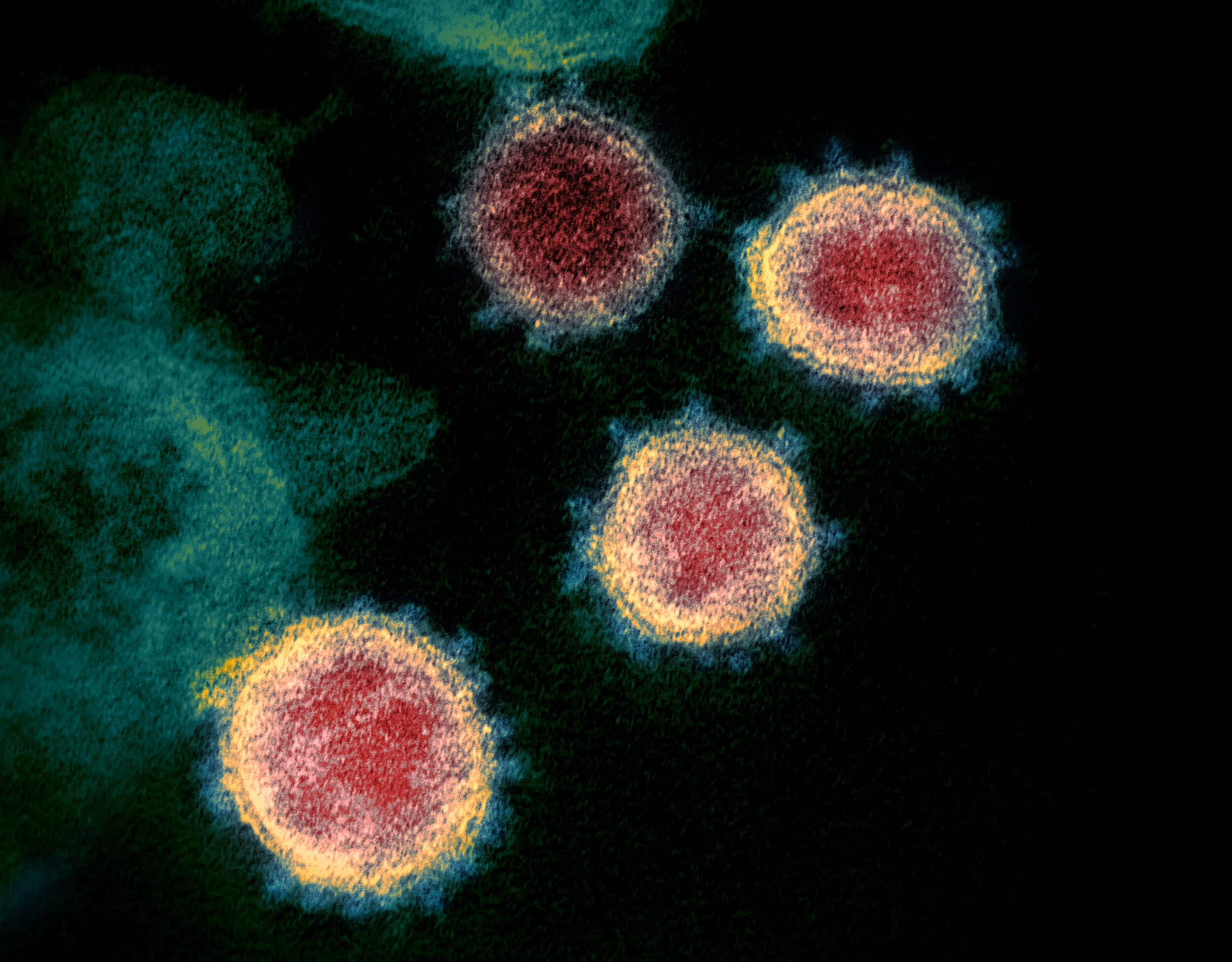
Thinking through COVID-19

This transmission electron microscope image shows SARS-CoV-2—also known as 2019-nCoV, the virus that causes COVID-19—isolated from a patient in the U.S. Virus particles are shown emerging from the surface of cells cultured in the lab. The spikes on the outer edge of the virus particles give coronaviruses their name, crown-like. Credit: NIAID-RML
In their recent article, ‘Who gets the ventilator in the coronavirus pandemic?’, bioethicists Julian Savulescu and Dominic Wilkinson note that we may soon be faced with a situation in which the demand for medical resources is greater than what is available (1). At that point, decisions about who gets what medical resources ought to be just, they argue. The trouble with the article however, is that the two men seem to approach our present crisis as though it were just that, a present tense phenomenon. They view COVID-19 not as a something that has emerged over time as a result of our social configuration and political choices, but as something that appeared out of nowhere, an atemporal phenomenon.
Treating the pandemic as atemporal means that the two scholars only focus on the fact of this individual here and that one over there, suffering in this moment, from the same condition. They fail to ask how how this person came to be prone to the virus, or what resources that person has had at their disposal, let alone the socio-political and historical circumstances by which those resources were acquired. Karla Holloway, Professor of English and Professor of Law, makes the point that stripping away the textual details around our two patients simplifies the decision making process, but the price paid for that efficiency might be justice (2). We know that there are systematic discrepancies in medical outcomes for marginalised groups at the best of times (3). We know that structural inequalities inform discrepancies around the degree to which people can practice social distancing and reduce the risk of infection (4). We know that those most likely to be most severely affected in the wake of the pandemic are those belonging to already marginalised communities (5). As public health medicine specialist, Papaarangi Reid, put it in a recent interview:
“We’ve got layers that we should be worried about. We should be worried about people who have difficulty accessing services … people who are stigmatised … While we are very worried about our elderly, we’re also worried about our precariat: those who are homeless; we’re worried about those who are impoverished; those who are the working poor; we’re worried about those who are in institutions, in prisons.” (6)
Every time Reid says that we ought to worry about this group or that, I am confronted by Arendt’s take on just how difficult it is to think in that manner. I’m currently teaching a Clinical Ethics course for second year medical students, one of whose central pillars is Hannah Arendt’s understanding of thought (7). Standing on the other side of the catastrophe that was the second world war, she warned that thinking is incredibly difficult; so much so it demands that one stop, and it can be paralysing. Arendt pointed out those algorithmic processes on the basis of which we usually navigate day-to-day life: clichés, conventional wisdom, the norms or ‘facts’ that seem so self-evident, we take them for granted. She argued that those are merely aids, prostheses if you like, which stand in the place of thinking - that labour of conceptually wading through a situation, or painstakingly kneading a problem. The trouble is, in times of emergency, where there is panic and a need for quick action, we are more likely to revert to our algorithms, and so reap the results of our uninterrogated and unresolved lapses and failures.
Australia today is a case in point. “The thing that I’m counting on, more than anything else,” noted Prime Minister Scott Morrison recently, “Is that Australians be Australian.” He went on to reiterate at the same press conference, “So long as Australians keep being Australians, we’ll get through this together.” (8)
I’m almost sympathetic to this position. A looming disaster threatens the status quo, so the head of that status quo attempts to reassure the public of the durability of the prevailing order. What goes unexamined in that reflex, however, is the nature of the order. The prime minister did not stop to think what ‘Australia’ and ‘Australianness’ mean in more ordinary times. Nor did he stop to consider recent protests by First Nations peoples, environmental activists, refugee and asylum seeker advocates and a raft of groups concerned about those harmed in the course of ‘Australians being Australian’. Instead, with the imperative to act decisively as his alibi, he propagated the assumption that whatever ‘Australia’ means, it ought to be maintained and protected. But what if that is merely the result of a failure to think adequately in this moment?
In his excellent article, calling on the nation to learn from past epidemics, Yuggera/Warangu ophthalmologist Kris Rallah-Baker, writes: ‘This is just the beginning of the crisis and we need to get through this together; Covid-19 has no regard for colour or creed’ (9). In one sense, he seems to arrive at a position that is as atemporal as that of Savulescu and Wilkinson, with a similar stripping away of particularity (colour and creed). It’s an interesting position to come to given the continuity between post-invasion smallpox and COVID-19 that his previous paragraphs illustrate. Read another way, I wonder if Rallah-Baker is provoking us; challenging us to think. What if this crisis is not the beginning, but the result of a longstanding socioeconomic, political and cultural disposition towards First Nations peoples, marginalised groups more broadly, and the prevailing approach to social organisation? Could it then also be the case that the effect of the presence of novel coronavirus in the community is in fact predicated, to some degree, on social categories such as race and creed? Might a just approach to addressing the crisis, even in the hospital, therefore need to grapple with temporal and social questions?
There will be many for whom the days and weeks ahead will rightly be preoccupied with the practical tasks before them: driving trucks; stacking supermarket shelves; manufacturing protective gear; mopping and disinfecting surfaces; tending to the sick; ensuring the continuity of government services; and so forth. For the rest of us, there is an imperative to think. We ought to think deeply about how we got here and where we might go after this.
Perhaps then, as health humanities researchers Chelsea Bond and David Singh recently noted in the Medical Journal of Australia:
“we might also come to realise the limitations of drawing too heavily upon a medical response to what is effectively a political problem, enabling us to extend our strategies beyond affordable prescriptions for remedying individual illnesses to include remedying the power imbalances that cause the health inequalities we are so intent on describing.” (10)
References
Savulescu J, Wilkinson D. Who gets the ventilator in the coronavirus pandemic? These are the ethical approaches to allocating medical care. ABC. 2020 29 March, 2020. https://www.abc.net.au/news/2020-03-18/ethics-of-medical-care-ventilator-in-the-coronavirus-pandemic/12063536.
Holloway K. Private Bodies, Private Texts: Race, Gender, and a Cultural Bioethics. Durham: Duke University Press; 2011.
WHO. Social determinants of health: World Health Organizaton. https://www.who.int/social_determinants/sdh_definition/en/
Ayyub R. Social Distancing Is a Privilege. Foreign Policy. 29 March, 2020. https://foreignpolicy.com/2020/03/28/social-distancing-is-a-privilege/
Fisher M, Bubola E. As Coronavirus Deepens Inequality, Inequality Worsens Its Spread. New York Times. 15 March, 2020. https://www.nytimes.com/2020/03/15/world/europe/coronavirus-inequality.html
Te Ao with MOANA. Dr Papaarangi Reid is clear that the pandemic strategy must be developed in partnership with Māori & through an equity lens. 17 March, 2020. https://twitter.com/TeAoWithMOANA/status/1239696884085616641
Arendt H. Thinking and Moral Considerations: A lecture. Social Research. 1971;38(3):417-46.
Marler D. "So long as Australians keep being Australians we'll get through this together." Scott Morrison's #covid19 advice to the nation. #auspol #qldpol. 15 March, 2020. https://twitter.com/qldaah/status/1239049502071222275?s=21
Rallah-Baker K. We should have learned from past epidemics that the only way through this crisis is together. The Guardian. 29 March, 2020. https://www.theguardian.com/commentisfree/2020/mar/26/we-should-have-learned-from-past-epidemics-that-the-only-way-through-this-crisis-is-together.
Bond CJ, Singh D. More than a refresh required for closing the gap of Indigenous health inequality. Medical Journal of Australia. 2020;:1-3. doi: 10.5694/mja2.50498